
Research
Our big questions about the terrestrial carbon cycle — and how to protect it.
Our big questions
We work across scales — from soil samples to satellites — to answer where land stores carbon, how much, and for how long.

How much carbon can we recapture in soils with cropland restoration?
Leveraging agricultural land’s natural ability to recapture and store previously lost soil organic carbon (SOC) is one of the most efficient, feasible, and scalable “natural climate solutions” at humanity’s disposal.

What are the feedbacks that link biodiversity and carbon storage?
Forest restoration holds major potential to capture carbon from the atmosphere.

How much nitrogen can plants absorb from the soil yearly?
Previous research determined that nutrients such as nitrogen are an important co-factor of plant growth, and therefore, plant carbon sequestration.

Has climate change helped sequester soil carbon?
The terrestrial system is considered a net carbon sink in the global carbon cycle, referred to as “the missing link”. However, whether the global soil carbon pool is a net sink or source is still not clear.

How do changes in vegetation dynamics affect biophysical properties in terrestrial ecosystems?
This research initiative aims to quantify the impact of vegetation dynamics and cover alterations on biophysical and biogeochemical properties in terrestrial ecosystems.

How do the increasing extreme storms affect the terrestrial carbon cycle?
The increase in extreme weather events caused by climate change has become more observable in recent years and can have profound impacts on the forest ecosystem.

What is the impact of nutrient limitation on the terrestrial carbon sink?
The role that nutrient limitation plays in constraining biomass is a major source of uncertainty in projections of the terrestrial carbon sink, and therefore our understanding of future climate change.

What is the contribution of peatlands to the global carbon cycle?
Peatlands hold a disproportionate share of the world’s soil carbon. We quantify their role in the global carbon cycle and their vulnerability to change.
Explore the science
Three interactive demos — drag the sliders to see the ideas behind our key findings.
Why some plants respond to rising CO₂ — and others barely do
Plants partner with two kinds of root fungi, and how much soil nitrogen is around changes everything. Set the nitrogen level, then drag the CO₂ dial.
The plant–soil carbon trade-off
Under rising CO₂, the ecosystems that grow the most extra plant carbon tend to bank the least extra soil carbon. Drag from grassland to forest and watch the balance shift.
How animals grow forests
About 81% of tropical trees need animals to carry their seeds into cleared land. As fruit-eating birds and mammals decline, regrowing forest banks carbon far more slowly. Drag their abundance and watch the recovery rate.
The Hidden Link: How Losing Animal Seed Dispersers
Stalls Forest Carbon Recovery
Most tropical trees depend on birds and mammals to carry their seeds into cleared land. As those animals disappear, naturally regrowing forest accumulates carbon far more slowly.
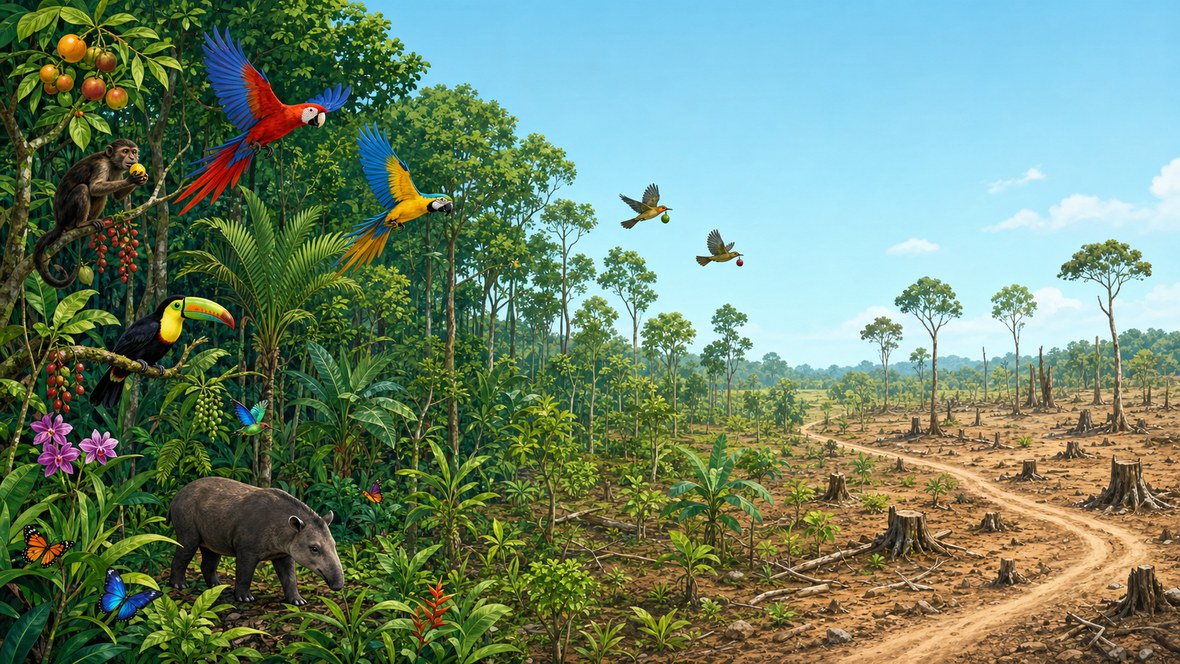
HEALTHY ECOSYSTEM
DEGRADED & FRAGMENTED
Most tropical tree species cannot reach cleared land without an animal to move their seeds — wind and gravity carry them only a short distance.
Forest regrowing with an intact animal community accumulates carbon about four times faster than where dispersal is most severely disrupted.
The loss is front-loaded
Carbon accumulation falls fastest as the first dispersers disappear, then flattens — so protecting a partly intact animal community buys far more carbon than trying to rescue an emptied one. Even fully defaunated forest still recovers slowly, so the curve bottoms out near 1, not zero.
Specific to natural regrowth
Planted monocultures show no such loss, because people do the dispersing. The penalty falls on forest left to recover on its own — which is most of it.
At a typical tropical restoration site, dispersers already missing today cut achievable carbon recovery by more than half — about −1.8 Mg C per hectare per year.
Of tropical areas whose regrowth potential shifted measurably between 2000 and 2020, the overwhelming majority got worse — human pressure keeps shortening the distances animals move.
PNAS 122, e2500951122 · based on 3,026 tropical regrowth plots · doi.org/10.1073/pnas.2500951122